
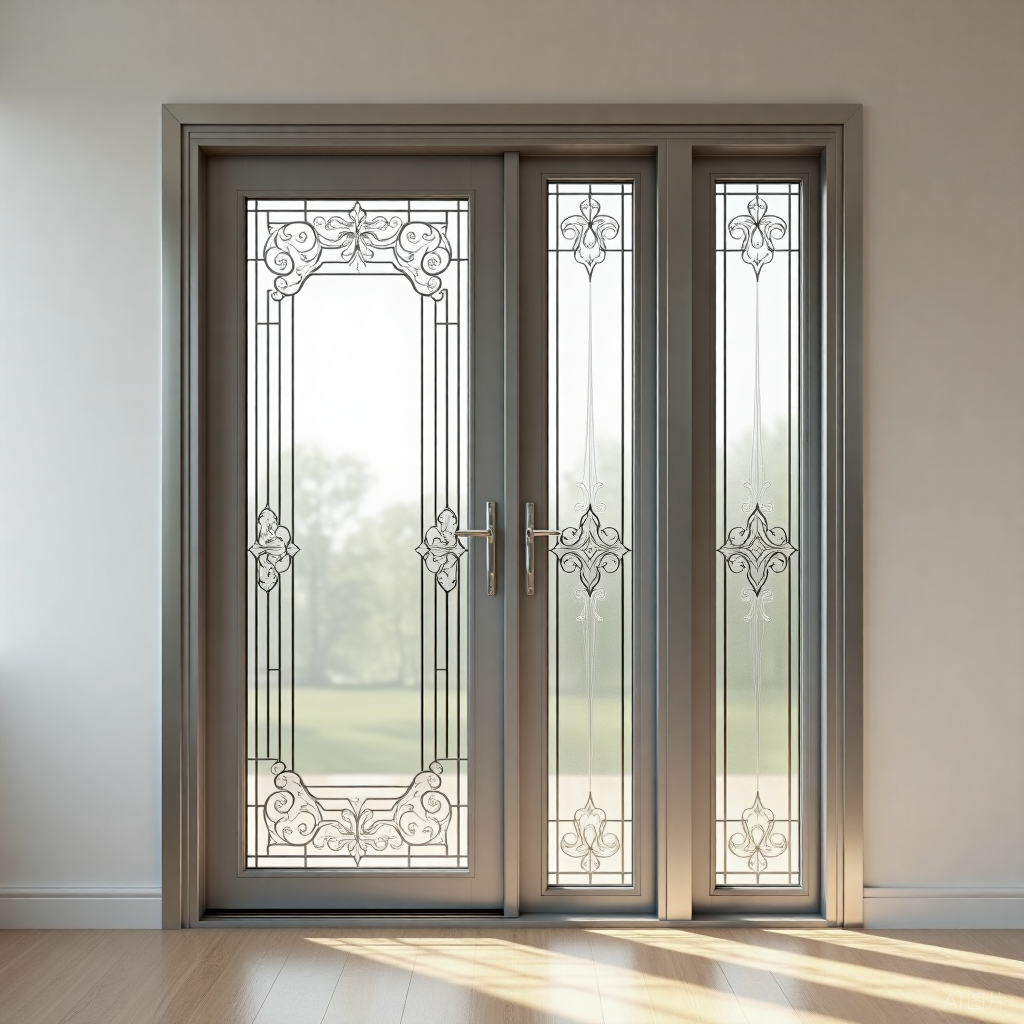
中国铝合金门窗进马来西亚:第一关不是价格,是标准 Chinese Aluminium Windows and Doors in Malaysia: the First Hurdle Is Standards, Not Price
2026年8月11日
本文面向中国的门窗、铝型材与幕墙企业,说明马来西亚为什么是一个“有真实需求、但门槛明确”的市场。文章先以马来西亚统计局数据说明建筑业仍在增长(2025年完成工作额1786亿令吉、同比增长12.5%,2026年一季度增长7.7%、二季度初步估算增长6.6%),再指出最关键的一关:铝合金窗(MS 832:2022)与铝框推拉玻璃门(MS 1017:2022)已纳入马来西亚建筑工业发展局(CIDB)的强制标准管理,自2023年9月1日起须满足PPS、PC等要求,境外工厂自2026年7月1日起须通过CIMIC系统在线办理验证。文章随后给出“6步轻量化进入法”、适合先试的企业类型、从“卖铝材”转向“卖系统”的思路,以及五个必须提前知道的风险,并说明ARFF中国运营中心可在前期提供哪些信息与资源协同。 This article is written for Chinese manufacturers of windows and doors, aluminium profiles and curtain walls, and explains why Malaysia is a market with genuine demand but clearly defined barriers to entry. It begins with Department of Statistics Malaysia (DOSM) data showing that construction is still growing — RM178.6 billion of work done in 2025, up 12.5 per cent year on year, with growth of 7.7 per cent in the first quarter of 2026 and an advance estimate of 6.6 per cent in the second quarter — and then sets out the decisive hurdle: aluminium alloy windows (MS 832:2022) and aluminium framed sliding glass doors (MS 1017:2022) fall under the mandatory standards administered by the Construction Industry Development Board Malaysia (CIDB), with PPS and PC requirements applying since 1 September 2023 and overseas factories required to submit verification online through the CIMIC system from 1 July 2026. The article then offers a six-step, asset-light entry approach, the types of enterprise best suited to trying first, a shift from selling aluminium to selling a system, and five risks to know in advance. It closes with the information and resource coordination the ARFF China Representative Office can provide at the early stage.
先说结论
The conclusion first
马来西亚不是“拿中国门窗直接过去就能卖”的低门槛市场,但它有真实的建筑需求、明确的产品标准和可验证的进入路径。对有系统门窗、工程配套、成本控制和定制能力的中国企业,更适合采用“小范围合规验证 + 项目试单 + 本地合作”的方式进入。
Malaysia is not a low-barrier market where Chinese windows and doors can simply be shipped in and sold. It does, however, have genuine construction demand, clear product standards and a verifiable route to entry. For Chinese enterprises with window and door systems, project supply capability, cost control and customisation, the more suitable approach is small-scale compliance validation, followed by trial orders on real projects, supported by local cooperation.
一、为什么值得关注“铝合金门窗”?因为这个行业非常典型。
1. Why is "aluminium windows and doors" worth attention? Because the industry is highly typical.
中国已经拥有成熟的铝型材挤压、表面处理、玻璃、五金、密封系统、系统门窗和工程交付产业链;而马来西亚同时拥有持续增长的建筑市场、热带气候下长期存在的门窗需求,以及较明确的强制标准体系。
China already has a mature industrial chain covering aluminium profile extrusion, surface finishing, glass, hardware, sealing systems, systems-based windows and doors, and project delivery. Malaysia, for its part, combines a construction market that is still growing, persistent demand for windows and doors under a tropical climate, and a relatively clear system of mandatory standards.
对很多中国门窗老板而言,出海听起来像“设厂、买地、建海外团队”。实际上,第一步完全可以更轻:先选一个门窗系统,核对标准和认证要求,找一个真实的马来西亚进口商或项目伙伴,完成样品与成本测试,再决定是否扩大。
For many Chinese window and door business owners, going global sounds like building a factory, buying land and setting up an overseas team. In practice, the first step can be far lighter: choose one window or door system, check the standards and certification requirements, find a genuine Malaysian importer or project partner, complete sample and cost testing, and only then decide whether to scale up.
真正值得关注的不是“马来西亚有没有门窗”,当地当然已经有成熟本地企业;真正的机会在于:中国企业能否用更好的系统设计、供应链效率、定制速度、工程配套和性价比,进入当地正在增长的项目市场。
The real question is not whether Malaysia has windows and doors — it of course has established local manufacturers. The opportunity lies in whether Chinese enterprises can enter the country's growing project market through better system design, supply chain efficiency, customisation speed, project supply capability and price-performance.
二、先看市场:马来西亚建筑业仍在增长
2. The market first: Malaysian construction is still growing
马来西亚统计局(DOSM)公布的数据显示,2025年全国建筑业完成工作额达到1786亿令吉,同比增长12.5%。进入2026年后,建筑业仍保持正增长:一季度增长7.7%,二季度初步估算增长6.6%。这说明建筑活动仍然活跃,为门窗、幕墙、玻璃、五金、密封材料等建筑配套产品提供了持续的需求基础。
Data published by the Department of Statistics Malaysia (DOSM) shows that construction work done nationwide reached RM178.6 billion in 2025, an increase of 12.5 per cent year on year. Construction has remained in positive growth in 2026: 7.7 per cent in the first quarter, with an advance estimate of 6.6 per cent in the second quarter. Construction activity therefore remains buoyant, providing a sustained basis of demand for windows and doors, curtain walls, glass, hardware, sealing materials and other building products.
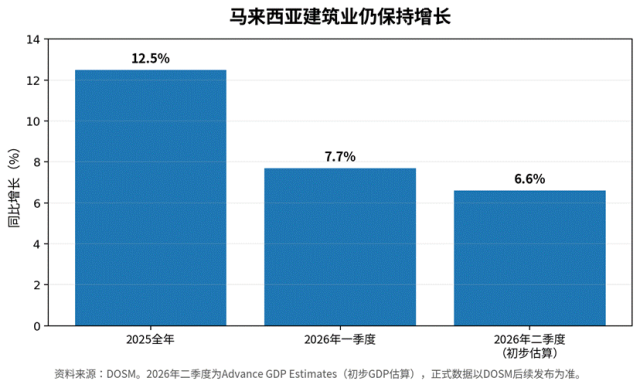
图1|马来西亚建筑业增长情况。资料来源:DOSM;2026年二季度为初步估算
Figure 1 | Growth of Malaysia's construction sector. Source: DOSM; the second quarter of 2026 is an advance estimate.
再看2025年第四季度的结构:非住宅建筑完成工作额约140亿令吉,住宅建筑约105亿令吉。对于铝合金门窗企业而言,这两类建筑都与门窗、推拉门、玻璃系统、幕墙及相关工程配套高度相关。这里必须强调:建筑完成工作额不能直接等同于门窗市场规模,但它能够反映项目端的“需求土壤”。
Looking at the composition in the fourth quarter of 2025: non-residential buildings accounted for about RM14.0 billion of work done and residential buildings about RM10.5 billion. For aluminium window and door manufacturers, both categories are closely linked to windows and doors, sliding doors, glazing systems, curtain walls and related project supply. It must be stressed here that construction work done cannot be equated directly with the size of the windows and doors market, but it does reflect the demand base at project level.
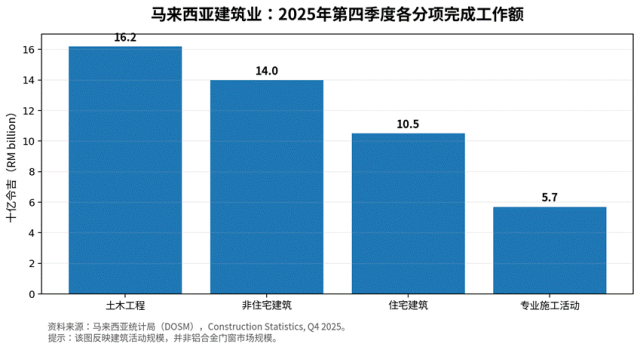
图2|2025年第四季度马来西亚建筑业各分项完成工作额;该图不是门窗市场规模
Figure 2 | Work done by segment in Malaysia's construction sector, fourth quarter of 2025. The chart does not represent the size of the windows and doors market.
对中国企业的启示 这不是一个“从零创造需求”的市场。中国企业首先要做的是找到增长中的项目场景,并证明自己的产品能够合规、稳定、按当地要求交付。
What this means for Chinese enterprises: this is not a market where demand has to be created from nothing. The first task for Chinese enterprises is to identify the project segments that are growing, and to demonstrate that their products can be delivered compliantly and consistently to local requirements.
三、哪些场景更值得中国企业先研究?
3. Which segments should Chinese enterprises study first?
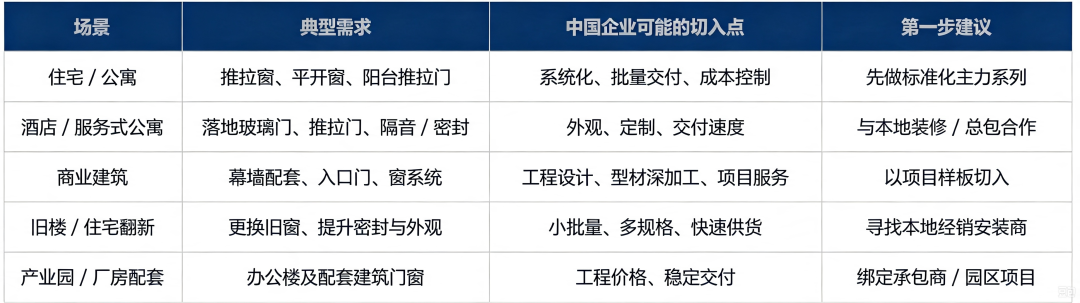
对第一次进入马来西亚的企业,通常不建议一开始就用“全产品目录”去找客户。更有效的方式是,从1—2套最有竞争力的窗/门系统开始,形成清楚的产品参数、测试资料、报价逻辑和安装节点。
For enterprises entering Malaysia for the first time, approaching customers with a full product catalogue is generally not advisable. A more effective approach is to start with one or two of the most competitive window or door systems and build up clear product parameters, test documentation, pricing logic and installation details.
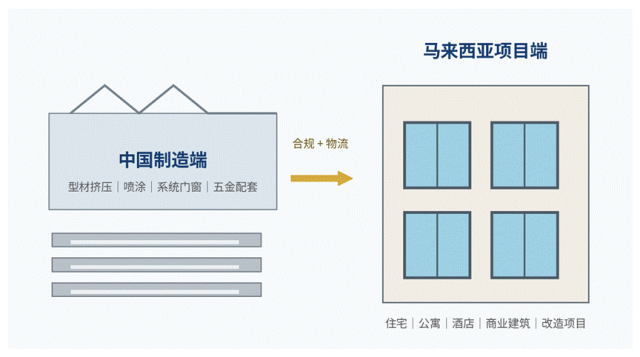
示意图|中国制造端的供应链能力,需要通过合规、物流和本地项目服务转化为马来西亚的实际交付能力
Illustration | The supply chain capability of Chinese manufacturing has to be converted into actual delivery capability in Malaysia through compliance, logistics and local project services.
四、最重要的一关:马来西亚门窗不是“装柜就能卖”
4. The most important hurdle: in Malaysia, windows and doors cannot simply be loaded into a container and sold
这正是本篇最需要中国企业老板看懂的地方。马来西亚CIDB(Construction Industry Development Board,马来西亚建筑工业发展局)已将相关铝合金门窗产品纳入强制标准管理。
This is the point that Chinese business owners most need to understand. CIDB Malaysia (Construction Industry Development Board) has brought the relevant aluminium window and door products under mandatory standards control.
铝合金窗:MS 832:2022《Aluminium Alloy Windows》
Aluminium alloy windows: MS 832:2022, Aluminium Alloy Windows
铝框推拉玻璃门:MS 1017:2022《Aluminium Framed Sliding Glass Doors》
Aluminium framed sliding glass doors: MS 1017:2022, Aluminium Framed Sliding Glass Doors
CIDB官方信息显示,这两项标准自2023年9月1日起实施合规要求,并涉及PPS(Perakuan Pematuhan Standard,标准符合性认证)和PC(Product Certificate,产品认证)等环节。
According to CIDB's official information, compliance with both standards has been required since 1 September 2023, and involves PPS (Perakuan Pematuhan Standard, the Standard Compliance Certificate) and PC (Product Certificate), among other steps.
对于境外生产企业,还要特别注意一个2026年的新变化:CIDB的CCPM(Construction Product & Material,建筑产品与材料认证平台)公告显示,自2026年7月1日起,境外工厂和产品验证申请通过CIMIC(CIDB Imported Material Inspection & Compliance,CIDB进口材料检查与合规系统)在线办理,旧的纸质/旧注册方式不再接受。此前CIDB也已要求境外工厂和产品进行更严格的物理验证。
Overseas manufacturers should also note a change taking effect in 2026: an announcement on CIDB's CCPM (Construction Product & Material) certification platform states that, from 1 July 2026, applications for the verification of overseas factories and products must be submitted online through CIMIC (CIDB Imported Material Inspection & Compliance), and the previous paper-based and legacy registration routes are no longer accepted. CIDB had already been requiring more rigorous physical verification of overseas factories and products.
关键提醒 “有CE、有中国国标、有第三方报告”不等于自动满足马来西亚要求。具体型号应按马来西亚现行标准、CIDB认可的认证/检测机构要求以及进口监管要求逐项核验。
A key reminder: having CE marking, Chinese national standards and third-party reports does not mean Malaysian requirements are automatically met. Each specific model should be verified item by item against the current Malaysian standards, the requirements of the certification and testing bodies recognised by CIDB, and import control requirements.
此外,实际进口前还应由马来西亚进口商/报关代理确认具体HS编码是否属于《Customs (Prohibition of Import) Order 2023(2023年海关禁止进口令)》的限制品类,以及是否涉及COA(Certificate of Approval,批准证书)、ePermit(电子许可)等进口手续。若符合ACFTA(ASEAN-China Free Trade Area,中国—东盟自由贸易区)原产地规则,可研究使用Form E(中国—东盟自贸协定原产地证书)申请优惠关税,但最终税率必须以具体HS编码和当期海关规则为准。
Before actual import, the Malaysian importer or customs broker should also confirm whether the specific HS code falls within a restricted category under the Customs (Prohibition of Import) Order 2023, and whether import formalities such as COA (Certificate of Approval) and ePermit apply. Where the ACFTA (ASEAN–China Free Trade Area) rules of origin are met, the use of Form E (the ACFTA certificate of origin) to apply for preferential tariffs can be explored, but the final rate must always be determined by the specific HS code and the customs rules in force at the time.
五、中国企业怎样走?建议采用“6步轻量化进入法”
5. How should Chinese enterprises proceed? A six-step, asset-light entry approach
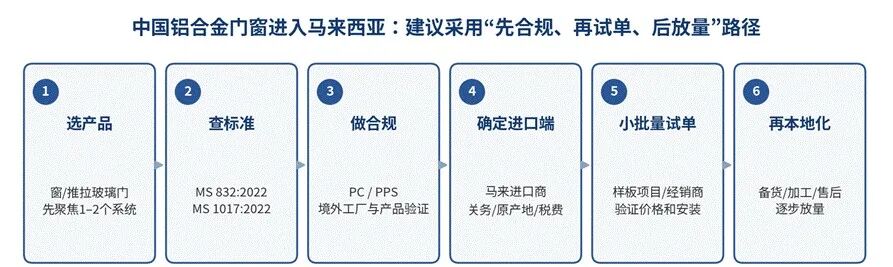
图3|建议路径:先把产品合规跑通,再用真实项目验证商业可行性
Figure 3 | The recommended route: get product compliance right first, then validate commercial viability through real projects.
第1步:只选1—2套主力系统
Step 1: Choose only one or two core systems
从企业现有产品中选最成熟、最有成本和质量优势的窗/推拉门系统,先不要把几十个系列全部拿出去。
Select the most mature window or sliding door system from the existing range — the one with the strongest cost and quality advantages. Do not take dozens of series to market at once.
第2步:做“马来西亚准入预审”
Step 2: Carry out a Malaysia market access pre-assessment
把产品结构、型材、玻璃、五金、测试报告、工厂体系资料整理清楚,对照MS 832:2022、MS 1017:2022以及CIDB现行要求核验。
Compile the product structure, profiles, glass, hardware, test reports and factory system documentation, and check them against MS 832:2022, MS 1017:2022 and CIDB's current requirements.
第3步:确定当地进口与项目责任主体
Step 3: Identify the local importer and the party responsible for the project
需要明确谁进口、谁报关、谁申请相应许可、谁负责本地安装和售后。第一次出海最忌讳“所有事情都等中国工厂自己摸索”。
It must be clear who imports, who handles customs declaration, who applies for the relevant permits, and who is responsible for local installation and after-sales service. The greatest pitfall on a first venture overseas is leaving everything for the Chinese factory to work out on its own.
第4步:用样品和样板项目验证市场
Step 4: Validate the market with samples and a pilot project
找本地门窗经销商、装修公司、承包商、开发商或项目采购方,用一套样品、一批试单或一个样板项目测试真实接受度。
Approach local window and door dealers, fit-out contractors, main contractors, developers or project buyers, and test genuine acceptance through a set of samples, a trial order or a pilot project.
第5步:算清“到项目现场”的完整成本
Step 5: Work out the full cost delivered to site
不要只比较中国出厂价。还要把认证检测、包装、海运、清关、税费、仓储、损耗、安装、售后和账期成本一起计算。
Do not compare ex-works prices in China alone. Certification and testing, packaging, ocean freight, customs clearance, duties and taxes, warehousing, wastage, installation, after-sales service and payment terms all need to be costed in.
第6步:验证成功后再本地化
Step 6: Localise only after successful validation
当订单、客户和安装服务逐步稳定,再考虑马来西亚备货、小型加工/组装、展示中心、本地团队,甚至更深度投资。
Once orders, customers and installation services have become reasonably stable, consider local stockholding in Malaysia, small-scale processing or assembly, a showroom, a local team, or even deeper investment.
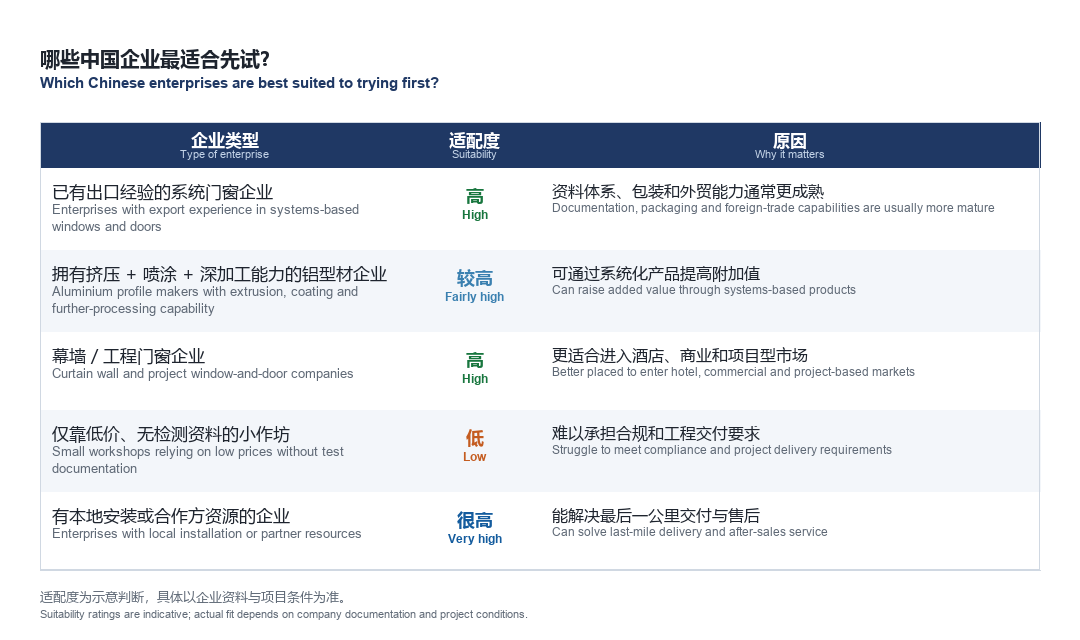
六、哪些中国企业最值得先试?
6. Which Chinese enterprises are best suited to trying first?
七、别只卖“铝”,要卖一套能交付的门窗系统
7. Do not sell aluminium alone — sell a window and door system that can be delivered
马来西亚本地已有铝业、门窗和幕墙企业,中国企业如果只靠“型材便宜”,很容易陷入价格竞争。真正更值得做的,是把产品从“材料”升级为“系统”。
Malaysia already has local aluminium, window and door, and curtain wall companies. Chinese enterprises that rely only on cheaper profiles will quickly be drawn into price competition. The more worthwhile move is to upgrade the product from a material to a system.
系统意味着:型材结构、玻璃配置、五金、密封、排水、表面处理、加工精度、安装节点、备件和售后被整体设计。对于热带高温、高湿、强降雨环境,产品的密封、防水、耐候、五金耐腐蚀和长期使用体验尤其需要在项目端验证。
A system means that the profile structure, glazing configuration, hardware, sealing, drainage, surface finishing, machining precision, installation details, spare parts and after-sales service are designed as a whole. In a tropical environment of high temperatures, high humidity and heavy rainfall, sealing, waterproofing, weather resistance, corrosion resistance of hardware and long-term user experience in particular need to be validated at project level.
如果企业能够做到“标准清楚、测试完整、报价透明、交付稳定、安装有人负责”,它进入马来西亚的竞争方式就会从单纯比铝价,变成比综合解决方案。
If an enterprise can achieve clear standards, complete testing, transparent pricing, stable delivery and clearly accountable installation, its basis for competing in Malaysia shifts from the price of aluminium to the strength of an integrated solution.
商业逻辑 中国企业的优势不应只停留在“便宜”,而要变成“相同预算下,给客户更完整的系统、更快的定制、更稳定的交付”。
The commercial logic: the advantage of Chinese enterprises should not stop at being cheaper. It should become offering customers a more complete system, faster customisation and more reliable delivery within the same budget.
八、五个风险,第一次做马来西亚一定要提前知道
8. Five risks to know in advance before a first venture into Malaysia
1)标准与型号不匹配 同一个工厂不同结构、尺寸、玻璃配置可能涉及不同测试与认证边界,不能拿一个证覆盖所有产品。
1) Standards and models may not match. Different structures, dimensions and glazing configurations from the same factory may fall within different testing and certification boundaries; one certificate cannot cover every product.
2)只报FOB价,不算落地成本 认证、海运、仓储、安装、售后和项目账期可能决定最终利润。
2) Quoting FOB only, without landed costs. Certification, ocean freight, warehousing, installation, after-sales service and project payment terms may determine the final margin.
3)只找代理,不验证项目能力 “有渠道”不等于有工程交付能力,应核验客户、安装团队、项目案例和付款能力。
3) Appointing an agent without verifying project capability. Having channels is not the same as being able to deliver on a project; the client, the installation team, past project references and payment capacity should all be checked.
4)忽视本地竞争 马来西亚已有成熟本地铝材和门窗供应链,中国企业要有明确差异化。
4) Overlooking local competition. Malaysia already has established local aluminium and window and door supply chains, so Chinese enterprises need clear differentiation.
5)一开始就重资产投资 在没有订单、渠道和合规验证前,不建议先租大仓、设大厂或大量备货。
5) Committing to asset-heavy investment at the outset. Before orders, channels and compliance have been validated, renting a large warehouse, setting up a large factory or holding substantial stock is not advisable.
九、给中国门窗老板的话:出海没有想象中那么远
9. A word to Chinese window and door business owners: going global is not as distant as it seems
中国有大量经营了十年、二十年的铝型材和门窗企业。工厂有设备、有技术、有工人、有稳定供应链,甚至已经把国内市场做到非常成熟。很多企业真正缺少的,并不是制造能力,而是有人把海外市场的规则、客户、价格和第一步给它讲清楚。
China has a great many aluminium profile and window and door businesses that have been operating for ten or twenty years. Their factories have equipment, technology, workers and stable supply chains, and in some cases they have already brought the domestic market to a high level of maturity. What many of them genuinely lack is not manufacturing capability, but someone to explain clearly the rules, the customers, the price levels and the first step in an overseas market.
马来西亚也不会因为“中国制造”四个字就自动给订单。机会要靠一项一项验证。但当一个企业能把成熟的中国制造能力,用当地认可的标准、当地能接受的价格和当地能持续服务的方式重新组织起来,海外市场就从一个模糊的概念,变成可以计算、可以试单、可以复盘的生意。
Malaysia will not hand out orders simply because a product is "made in China" either. Opportunity has to be validated point by point. But when an enterprise can reorganise mature Chinese manufacturing capability around standards the local market accepts, prices it can bear and a service model that can be sustained locally, an overseas market turns from a vague concept into a business that can be calculated, trialled and reviewed.
本期金句
Quote of the issue
也许你的下一个工程客户真的不在中国。出海第一步,不必先建海外工厂;先让一套门窗系统通过规则、价格和真实项目的三重验证。
Perhaps your next project client really is not in China. The first step overseas does not have to be an overseas factory; it is to let one window and door system pass a threefold validation — of rules, of price, and of a real project.
十、ARFF中国运营中心:先帮企业把第一步走清楚
10. ARFF China Representative Office: helping enterprises get the first step right
针对中国铝合金门窗、铝型材、幕墙和配套企业,ARFF中国运营中心可以围绕前期信息和资源协同,重点帮助企业把以下问题先梳理清楚:
For Chinese enterprises in aluminium windows and doors, aluminium profiles, curtain walls and related components, the ARFF China Representative Office can help clarify the following questions at the early stage, focusing on preliminary information and resource coordination:
• 产品是否适合马来西亚项目场景;
• whether the product suits Malaysian project conditions;
• MS 832 / MS 1017等标准是否涉及;
• whether standards such as MS 832 and MS 1017 apply;
• 现有测试报告和工厂资料还缺什么;
• what is still missing from the existing test reports and factory documentation;
• 马来西亚进口主体和本地合作方如何匹配;
• how to match a Malaysian importer with local partners;
• 适合先找经销商、承包商、开发商还是项目采购;
• whether to approach dealers, contractors, developers or project buyers first;
• 首批样品/试单如何设计;
• how to design the first samples or trial orders;
• 物流、税费、安装和售后成本如何纳入测算。
• how to factor logistics, duties and taxes, installation and after-sales costs into the calculation.
企业前期可以只提供:企业名称 + 所在城市 + 主营产品 + 现有出口情况 + 一句话需求。先判断,再投入;先验证,再放量。
At the early stage, an enterprise need only provide its company name, city, main products, current export situation and a one-line statement of its needs. Assess first, then invest; validate first, then scale.
说明
Note
本文为ARFF中国运营中心面向中国企业提供的市场科普与出海信息参考,不构成认证、关税、订单、投资或收益承诺。马来西亚建筑材料监管、海关税则和进口许可会动态调整,具体产品必须按照当期HS编码、产品结构、用途及主管部门要求逐项核验。
This article is market education and going-global information provided by the ARFF China Representative Office for Chinese enterprises. It does not constitute any commitment in respect of certification, tariffs, orders, investment or returns. Malaysia's construction material regulation, customs tariff schedule and import licensing are subject to change; each specific product must be verified item by item against the HS code, product structure, intended use and the requirements of the competent authorities in force at the time.
资料来源(均为官方来源)
Sources (all official)
马来西亚统计局(DOSM):Construction Statistics Fourth Quarter 2025;Gross Domestic Product Q1 2026;Advance GDP Estimates Q2 2026。
Department of Statistics Malaysia (DOSM): Construction Statistics Fourth Quarter 2025; Gross Domestic Product Q1 2026; Advance GDP Estimates Q2 2026.
马来西亚建筑工业发展局(CIDB):MS 832:2022、MS 1017:2022实施信息;CCPM建筑产品与材料认证平台;CIMIC境外工厂与产品验证公告。
Construction Industry Development Board Malaysia (CIDB): implementation information for MS 832:2022 and MS 1017:2022; the CCPM construction product and material certification platform; the CIMIC announcements on verification of overseas factories and products.
马来西亚皇家海关(RMCD):Import Procedure;Customs (Prohibition of Import) Order 2023相关提示;Rules of Origin FAQ(含ACFTA Form E说明)。
Royal Malaysian Customs Department (RMCD): Import Procedure; guidance relating to the Customs (Prohibition of Import) Order 2023; Rules of Origin FAQ (including guidance on ACFTA Form E).